The 00:47 Roll-Out: Tyneside's After-Hours Bike Commute in Their Own Words
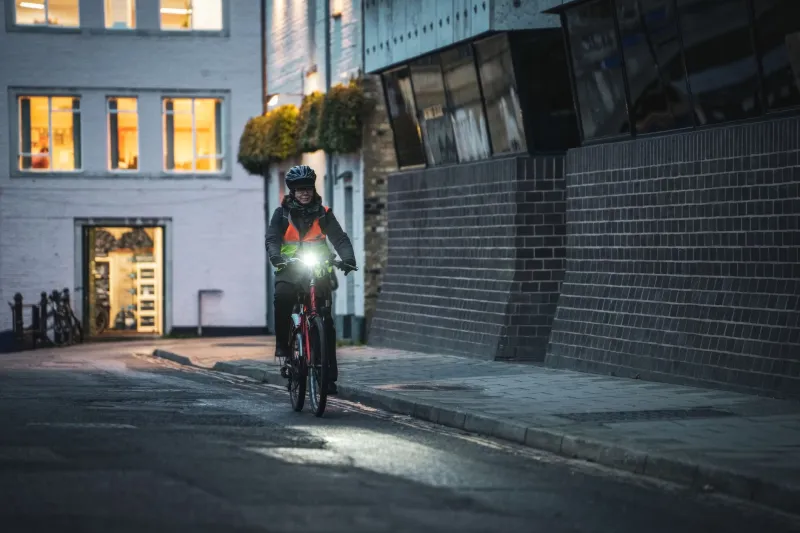
At 00:47 on a wet Tuesday in November 2026, the bike shelter outside the Royal Victoria Infirmary is the warmest-looking place on Queen Victoria Road. Inside, a nurse is wrestling a waterproof cover over a pannier, a porter is tightening a light bracket with his teeth, and two radiographers are comparing the merits of heated gloves. Nobody is in a hurry. The changeover is not a race. It is a slow, practised ballet, and it happens every night of the year.
The Shift Change That Doesn't Make the News
Aisha, 34, has been cycling from the RVI to Heaton for six years. She works in the emergency department and finishes at 00:30 three nights a week. Her bike is a second-hand hybrid with a milk crate zip-tied to the rear rack. The crate contains a reflective vest, a spare tube and a flask of tea that is usually cold by the time she reaches Sandyford Road.
'People think the roads are scary at night,' she says. 'They are quieter, not scarier. You hear the engine before you see the headlights. The tricky bit is the last mile, where the streetlights stop and the pavement starts to look like a patchwork quilt.'
Aisha's route takes her past the RVI, down Claremont Road, across the top of the city and along the back streets of Heaton. She knows every drain cover, every temporary traffic light and every corner where the camber sends you towards the kerb. In 2026, she says, the biggest change is not the traffic. It is the roadworks. 'Barrack Road has been a building site for what feels like a decade. You learn the diversions the way you learn a bus timetable.'
Four Riders, Four Very Different Midnights
Half a mile east, in Byker, Kasia is locking up a bakery at 00:20. She starts at 4am, finishes at midnight, and rides home to Jesmond on a singlespeed that she describes, fondly, as 'a shopping trolley with ambitions'. Her commute is 12 minutes in summer and 25 in winter. The difference is not the distance. It is the ice.
'In January I walk the last bit,' she says. 'The back lane behind the bakery holds water. It is fine in the dark because you cannot see how cold it is. That is the problem.'
Over in Team Valley, Danny is finishing a warehouse shift at 23:30. He rides to Dunston via the A1 cycle path, the Teams and the Redheugh Bridge. His route is the longest of the four — about seven miles — and the one with the most variable infrastructure. 'There is a lovely stretch where you feel like you are in the countryside,' he says. 'Then you hit a roundabout where the cycle lane disappears and you have to channel your inner traffic cone.'
Liam, 23, works in a bar in Ouseburn and rides home to Walker after 1am. He is the only one of the four who carries a spare battery for his lights. 'The Quayside is beautiful at that time,' he says. 'The bridges are lit up, there is nobody about, and you feel like you own the place. Then you get to Walker Road and remember you are still in Newcastle.'
Routes That Only Exist After Dark
The regulars describe a city that is mapped differently at night. The Tyne Bridge is a wind tunnel. The Swing Bridge is a cobbled lottery. The High Level Bridge is a good idea until you hit the metal grating. The waggonways are black as ink, and the coast road is a different beast when the chippies are shut.
Aisha's route home avoids the main roads. She uses the back lanes behind the RVI, cuts through the university quarter and joins the cycle track near the old brewery. Danny sticks to the A1 path because it is fast, lit in patches and wide enough to avoid the glass. Kasia's route is short enough to walk if the weather turns. Liam's is the one that changes most often, depending on which bars are open and which streets are closed for roadworks.
'You develop a sixth sense for a bad surface,' Danny says. 'You can hear it. A dull thud is a pothole. A crunch is a pothole with a surprise in it.'
What the Empty Roads Reveal
The after-hours commute is a useful stress test for infrastructure. A cycle lane that feels fine at 8am can feel very different at 1am, when the only light comes from a flickering lamp outside a closed shop. A junction that works in daylight can become a guessing game when the signal detection does not recognise a single bike. A locked shelter is a luxury. A pothole is a hazard with no audience.
The riders we spoke to were not asking for much. They wanted continuous lighting on the waggonways, secure storage at hospitals and warehouses, and a way to report a bad surface that does not involve a 20-minute phone call. They also wanted drivers to remember that a cyclist at 1am is probably not a hobbyist. They are a nurse, a baker, a warehouse worker or a barman. They are going home.
A Community With Its Own Signals
What struck us most was not the danger. It was the etiquette. There is a nod at 00:47 that means 'I see you'. There is a flash of a light at a junction that means 'after you'. There is a WhatsApp group called Night Shift Spokes, where riders share warnings about temporary lights, glass and the one pothole on Shields Road that has been there since the summer.
The group is informal and slightly chaotic. Someone posts a photo of a flooded underpass. Someone else replies with a route diversion. A mechanic offers to look at a sticky freehub on Sunday. It is mutual aid, Tyneside-style: low-key, practical and suspicious of fuss.
The Last Mile Home
The city after dark is not empty. It is quieter and more honest. The roads are not owned by anyone, exactly, but they are shared by a group of people who know them better than most. They know which streetlights are out. They know where the wind comes from. They know that the last mile is always the longest, and that a warm shower and a cup of tea are worth more than any Strava segment.
At 00:47, the bike shelter at the RVI empties in ones and twos. The riders peel off towards Heaton, Jesmond, Walker and beyond. The roads are quiet. The city is still awake. And somewhere between the last bus and the first bakery delivery, the after-hours peloton rolls out again.